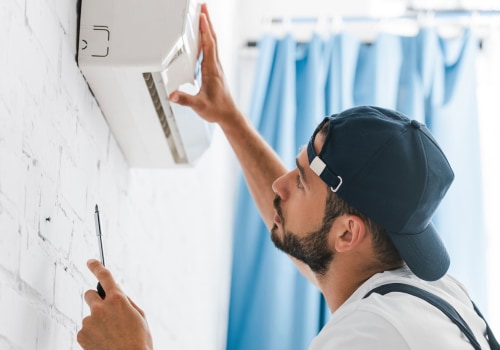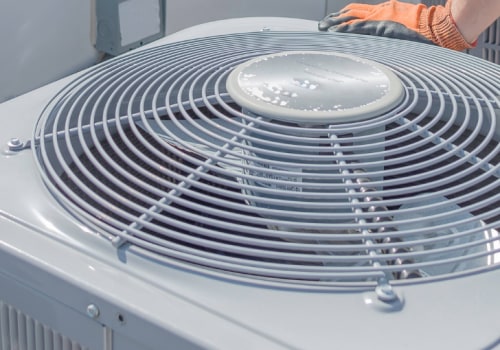
The homes we've walked into with the worst dust problems share a common pattern. It's almost never about how often the home gets cleaned. It's about what the HVAC system is doing between cleanings. Leaking ducts drawing unconditioned air from attic spaces. Return systems too undersized to pull air effectively from the rooms generating the most particulate. Filtration setups that were sized for the equipment — not for the home's actual air quality demands. Dust isn't the problem in these homes. It's the evidence.
Deltona's climate makes this worse than most generic advice accounts for. Year-round system operation means whatever the duct system is pulling in, it's pulling in constantly. Fine particulate matter moves freely through Florida air, and a system that isn't balanced and properly filtered doesn't just fail to capture that particulate — it redistributes it on every cycle.
What follows is a direct, experience-based assessment of the HVAC upgrades that actually reduce dust in Deltona homes — from filtration and duct sealing to return air balancing — and how to prioritize them based on what the system is actually doing to the air in the home.
TL;DR Quick Answers
Top HVAC System Installation Near Deltona FL
The top HVAC system installation near Deltona FL starts with a licensed, permitted contractor who performs a Manual J load calculation before recommending any equipment. For most Deltona homes, a variable-speed heat pump is the strongest system choice — it handles heating and cooling year-round, manages humidity more effectively than single-stage equipment, and runs longer cycles at lower capacity that give the filtration system more contact time with circulating air. Plan for $5,000 to $12,000 or more. What to confirm before signing:
Florida state license verified through myfloridalicense.com
Permit pulled through Volusia County Building and Zoning
Manual J load calculation included in the scope of work
Full duct assessment — leakage testing and insulation verification
Refrigerant charge confirmed by measurement — not estimate
Service twice per year — early spring and early fall
Improper installation increases household energy use by up to 30% (NIST) and duct leakage alone causes an average 37% loss in cooling efficiency (DOE). In Deltona's climate, where systems run close to year-round and attic temperatures regularly hit 130°F, installation quality determines comfort, dust control, humidity management, and operating costs for the life of the system. Qualifying high-efficiency systems may be eligible for federal tax credits up to 30% through ENERGY STAR. The lowest bid is almost always the shortest scope — and in Deltona's climate, a short scope is a long problem.
Top Takeaways
Chronic dust is almost never a filtration problem — it's a duct system problem. A better filter captures more of what the duct system distributes. It does not stop the distribution. Three root causes account for most chronic dust in Deltona homes:
Duct leakage pulling unfiltered air from attic spaces and wall cavities
Undersized or poorly positioned return air vents
Filtration mismatched to the system's actual airflow capacity
Duct leakage is the most consequential — and most overlooked — contributor to chronic dust. Two things enter the living space through the same gap:
Efficiency loss — DOE field research confirms an average 37% cooling efficiency loss from duct leakage alone
Unfiltered dust, insulation particulate, and biological material pulled directly from attic spaces
70 to 90% of home HVAC systems have at least one fault affecting both efficiency and air quality. In most homes assessed across Volusia County, the fault is not in the equipment. It is in the airflow infrastructure surrounding it:
Undersized returns
Leaking duct joints
Unbalanced supply runs
Deltona's climate makes these failures more damaging than most advice accounts for:
Attic temperatures regularly hit 130°F — duct insulation failures that would be marginal elsewhere become significant here
Persistent humidity means biological particulate travels alongside dust
Year-round operation means no seasonal reset — the system distributes what it pulls in every day
Dust in a Deltona home is a diagnostic question before it's a product question. The sequence that produces lasting results:
Duct sealing and leakage assessment first
Return air balance correction second
Filtration matched to the corrected system third
Why Dust Keeps Coming Back in Deltona Homes
Dust returns because the conditions creating it never change. In Deltona, those conditions include year-round system operation, persistent humidity that causes particulates to settle and resettle, and homes that were often built with duct systems designed for baseline comfort — not air quality management. Cleaning removes what's visible. The HVAC system determines what comes back and how fast.
Three root causes account for the majority of chronic dust problems we identify in Volusia County homes:
Duct leakage pulling unconditioned air from attic spaces, wall cavities, and crawl spaces directly into the living area
Undersized or poorly positioned return air vents that can't effectively pull air from the rooms generating the most particulate
Filtration that was specified for the equipment — not for the home's actual air quality demands
Address the root cause and the dust problem changes. Address only the symptom and it comes back on the next cycle.
The Role Filtration Actually Plays — and Where Most Systems Fall Short
Filtration is the most commonly upgraded component in a dust reduction effort — and the most commonly misunderstood. A higher MERV rating captures more particulates. But a filter the system wasn't designed to handle creates a different problem: restricted airflow that causes the system to work harder, pull air through gaps and bypasses instead of through the filter, and ultimately distribute more particulate than a lower-rated filter would have.
After manufacturing filters for over a decade and serving more than two million households, the filtration failures we see most consistently in Deltona homes fall into two categories:
Filters that are too restrictive for the system's blower capacity — creating negative pressure that pulls dusty air around the filter rather than through it
Filters that are correctly rated but incorrectly sized — gaps around the filter frame that allow unfiltered air to bypass the media entirely
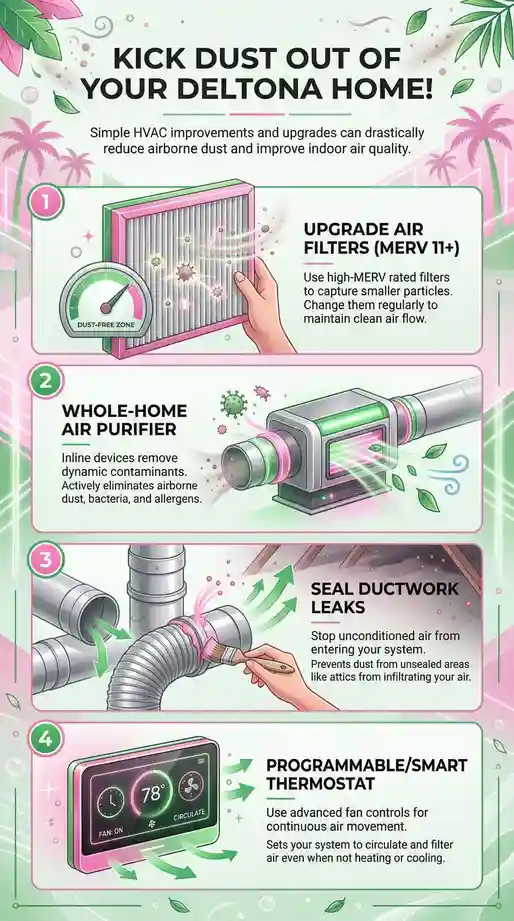
The practical answer for most Deltona homes is a MERV 11 filter matched specifically to the system's airflow capacity, changed on a schedule the system's runtime actually demands — not a calendar reminder that ignores how hard the system is working.
Duct Leakage: The Dust Source Most Homeowners Never See
In Deltona homes with attic-run duct systems, duct leakage is consistently the largest single contributor to chronic dust. The physics are straightforward. When supply ducts leak into unconditioned attic space, the system loses pressure. To compensate, return ducts pull harder — and they pull from wherever air is available. That includes wall cavities, ceiling penetrations, and attic spaces where dust, insulation particulate, and biological material accumulate undisturbed.
What enters through a leaking return system doesn't get filtered before it enters the living space. It enters directly. In homes we've assessed across Volusia County, duct leakage accounts for more of the visible dust load than any other single factor — including filtration grade.
DOE-reviewed field research found that duct leakage and inadequate insulation cause an average 37% loss in overall cooling efficiency. The dust impact runs parallel to the efficiency impact. A leaking duct system is simultaneously costing money and distributing particulates through every room the system serves.
The fix is duct sealing — either through mastic application at accessible joints or aerosol-based sealing methods like Aeroseal for systems where leakage points are distributed and hard to access directly.
Return Air Balancing: The Upgrade Most Contractors Skip
Return air is the least discussed component of residential HVAC design and one of the most consequential for dust control. A system that can't pull air back effectively from the rooms it serves creates pressure imbalances. Those imbalances pull air through gaps in the building envelope — under doors, around electrical outlets, through recessed lights — instead of through the return system. That infiltration air carries whatever is in the wall cavities and building structure directly into the living space.
In Deltona homes, we regularly identify return systems that were designed for the original floor plan and never updated after renovations, room additions, or furniture configurations that block return airflow. The result is predictable:
Rooms that feel dustier than others despite identical cleaning schedules
Pressure imbalances that pull outdoor air and particulate through the building envelope
A system that is moving air — but not managing it
Adding dedicated return vents to underserved rooms, installing transfer grilles above interior doors, or upsizing the central return are the most direct interventions. The right solution depends on the specific pressure map of the home.
Whole-Home Air Purification: When Filtration and Duct Sealing Aren't Enough
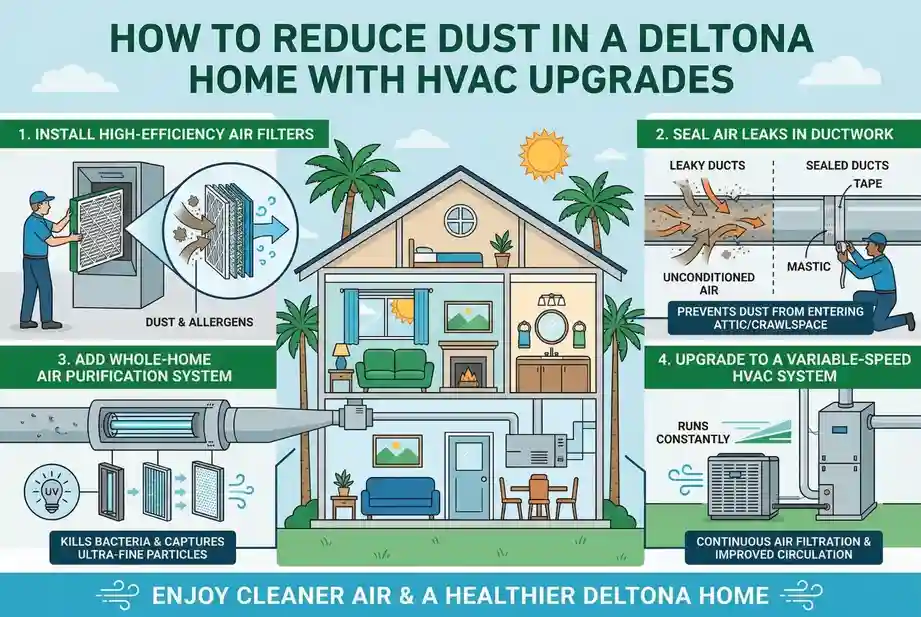
For Deltona homes with persistent dust problems that duct sealing and filtration upgrades haven't fully resolved, whole-home air purification adds a layer of particulate capture that portable units and standard filtration cannot match. Systems installed directly in the air handler treat every cubic foot of air the system moves — not just the air that passes through a single room unit.
The options most relevant to Deltona's climate and air quality conditions:
Media air cleaners installed in the return plenum — high-capacity filtration that captures fine particulate without the airflow restriction of high-MERV panel filters
Electronic air cleaners that use electrical charge to capture particulate too fine for mechanical filtration
UV light systems that address biological particulate — mold spores and bacteria that are particularly relevant in Deltona's humid operating environment
Whole-home purification works alongside a sealed, balanced duct system — not as a substitute for one. The most effective dust reduction outcomes we've seen in Volusia County homes combine all three layers: sealed ducts, correctly matched filtration, and a whole-home purification component for fine particulate that mechanical filtration alone doesn't capture.
When the Right Answer Is a Full System Assessment
Some dust problems in Deltona homes are straightforward — a filter upgrade and a duct sealing job resolve them. Others reflect a system that was never designed for the home it's serving. Undersized return systems, improperly balanced supply runs, and duct layouts that made sense for the original construction but not for how the home is actually lived in today all contribute to chronic dust that individual upgrades won't fully address.
The most useful first step in those cases isn't purchasing an upgrade. It's a system assessment that identifies where the air is going, where it's being pulled from, and what the pressure relationships between rooms are telling you about how the building is actually breathing. In our experience across Volusia County, that assessment changes the upgrade conversation significantly — and almost always results in a more targeted, more cost-effective solution than starting with equipment, a standard approach used by a top HVAC system installation service.
"Chronic dust in Deltona homes is almost never a filtration failure — it's a duct system telling you something. We've walked into homes where the homeowner had upgraded to the highest MERV filter available and was still wiping surfaces down twice a week. The filter was clean. The ducts were the problem. Fix the duct system, balance the returns, then match the filtration. In that order. The filter is the finish line. Experienced HVAC installation companies understand that solving the duct system first is what truly reduces dust and improves overall indoor air quality."
Essential Resources
1. Understand the Filter Rating System Before Buying Another Filter U.S. EPA — What Is a MERV Rating? | epa.gov One of the most common mistakes we see in Deltona homes is a well-intentioned filter upgrade that creates an airflow problem worse than the dust problem it was meant to solve. The EPA's official MERV rating resource explains what the scale actually measures and how to choose the right rating for your specific system — before the wrong filter makes things worse. https://www.epa.gov/indoor-air-quality-iaq/what-merv-rating
2. Know What Whole-Home Filtration Can — and Can't — Do Before You Invest U.S. EPA — Guide to Air Cleaners in the Home | epa.gov We've walked into Deltona homes where homeowners had invested in whole-home purification systems that weren't addressing the particulate type causing the problem. The EPA's guide covers in-duct filtration, portable air cleaners, CADR ratings, and what each option realistically captures — so neighbors can make an informed decision before spending money on the wrong solution. https://www.epa.gov/indoor-air-quality-iaq/guide-air-cleaners-home
3. Understand How Your HVAC System Is Contributing to the Dust Problem U.S. EPA — Improving Indoor Air Quality | epa.gov After years of servicing homes across Volusia County, the dust conversation almost always leads back to the same place — the HVAC system. Infiltration through building envelope gaps, unbalanced ventilation, and inadequate filtration are among the most common drivers of chronic indoor dust. This EPA resource helps Deltona homeowners understand what their system may be doing to the air before they consider any upgrade. https://www.epa.gov/indoor-air-quality-iaq/improving-indoor-air-quality
4. Learn Why Duct Sealing Is the Upgrade Most Dust Problems Actually Need U.S. Department of Energy — Minimizing Energy Losses in Ducts | energy.gov In our experience across Volusia County, duct leakage is the most consistently underestimated contributor to chronic dust in Deltona homes. When ducts run through unconditioned attic space and leak, the system pulls in whatever is up there — insulation particulate, biological material, accumulated dust — before the air ever reaches a filter. The DOE's resource on duct sealing explains why sealing is the most consequential upgrade in most homes we've assessed. https://www.energy.gov/energysaver/minimizing-energy-losses-ducts
5. Get the DOE's Guidance on Return Air Balancing and Filter Maintenance U.S. Department of Energy — Operating and Maintaining Your Heat Pump | energy.gov Return air imbalances are one of the most overlooked dust contributors we identify in Deltona homes — rooms that feel dustier than others despite identical cleaning schedules almost always have a return air problem, not a cleaning problem. This DOE resource covers return air balancing, airflow verification, and filter maintenance schedules directly relevant to homes running heat pump systems year-round in Florida's climate. https://www.energy.gov/energysaver/operating-and-maintaining-your-heat-pump
6. Consult the Organization That Wrote the MERV Rating Standard ASHRAE — Filtration and Disinfection FAQ | ashrae.org ASHRAE developed the MERV rating system and provides the most technically authoritative guidance available on filter selection, pressure drop impacts, and the practical limits of in-duct filtration. Before any Deltona homeowner upgrades to a higher-rated filter, this resource answers the questions most installers never raise — and some that can save a system from being damaged by a well-meaning upgrade. https://www.ashrae.org/technical-resources/filtration-and-disinfection-faq
7. Verify Your Contractor Is Licensed Before Any Upgrade Work Begins Florida DBPR — Contractor License Lookup | myfloridalicense.com Duct sealing, return air balancing, and whole-home filtration upgrades all require licensed HVAC work under Florida law — and we'd want any neighbor in Deltona to confirm that before signing anything. The DBPR license lookup takes less than a minute and is the single most important step before any contractor sets foot in your home. https://www.myfloridalicense.com/wl11.asp
These resources help homeowners researching HVAC system installation near me understand how filtration ratings, duct sealing, airflow balance, and licensed contractor work all influence indoor air quality, dust levels, and overall HVAC system performance before choosing upgrades or installation services.
Supporting Statistics
Americans spend approximately 90% of their time indoors — where concentrations of some pollutants are often 2 to 5 times higher than typical outdoor concentrations.
Most Deltona homeowners think of dust as a surface problem. Something visible. Something that gets wiped down and comes back. What the EPA's data points to is more consequential. The air cycling through the home every time the HVAC system runs is where the real exposure is happening. In Deltona, where year-round system operation keeps homes closed and systems running almost continuously, whatever moves through the duct system moves through it constantly. We walked into homes where surfaces were already showing dust accumulation the day after a thorough cleaning. That's not a cleaning frequency problem. That's a circulation problem — and the duct system is almost always where it originates.
Source: U.S. EPA — Indoor Air Quality Report on the Environment https://www.epa.gov/report-environment/indoor-air-quality
DOE-reviewed field research found that duct leakage and inadequate insulation cause an average 37% loss in overall cooling efficiency — before any other installation fault is counted.
The efficiency loss and the dust load enter the living space through the same gap. Here is what we consistently find when assessing homes across Volusia County:
Supply ducts leaking into attic space lose pressure
The return system compensates by pulling harder — from wherever air is available
That includes wall cavities, ceiling penetrations, and attic spaces where dust and insulation particulate have accumulated for years
That material enters the living space directly — unfiltered
Seal the duct system and both problems improve simultaneously. Because they were caused by the same thing.
Source: U.S. Department of Energy — Residential HVAC Installation Practices: A Review of Research Findings https://www.energy.gov/eere/buildings/articles/residential-hvac-installation-practices-review-research-findings
DOE research found that 70 to 90% of home heating and cooling systems have at least one energy-wasting fault — with improper airflow, duct leakage, and oversized equipment among the most commonly identified.
After years of servicing homes across Deltona, that range maps almost exactly to what we find in the field. Three patterns stand out consistently:
The faults are almost never in the equipment itself — they're in the airflow infrastructure surrounding it
Undersized returns, leaking duct joints, and unbalanced supply runs are the most common culprits
These are the same conditions driving chronic dust — and the same ones most contractors never assess
Addressing them doesn't require a new system. It requires the kind of targeted assessment most homeowners never get quoted.
Source: U.S. Department of Energy — Smart Tools for Efficient HVAC Performance Campaign https://www.energy.gov/eere/buildings/about-smart-tools-efficient-hvac-performance-campaign
These statistics show how professional HVAC system installation plays a central role in reducing dust circulation and improving indoor air quality by correcting duct leakage, balancing airflow, and ensuring the entire HVAC system operates efficiently in homes where air is constantly recirculating.
Final Thoughts
Deltona homeowners dealing with chronic dust have usually already spent money trying to solve it — a better filter, a portable air purifier, more frequent cleaning. In most cases, none of it produced a lasting result. Because none of it addressed what was actually causing the problem.
After years of assessing homes across Volusia County, our honest perspective is this:
Chronic dust in a Florida home is almost never a filtration problem
It is almost always a duct system problem
A better filter captures more of what the duct system is distributing — it does not stop the duct system from distributing it
That distinction changes where the solution starts.
The homes that saw the most significant and lasting dust reduction shared a common sequence:
Duct sealing first
Return air assessment first
Filtration matched to what the system could actually move — after the delivery infrastructure was addressed
In that order, the results held. In the reverse order, they rarely did.
Deltona's climate makes this more consequential than generic dust reduction advice accounts for:
Year-round system operation means the duct system distributes whatever it's pulling in every day — without the seasonal breaks that give other climates a natural reset
Attic temperatures regularly hitting 130°F make duct insulation failures far more significant here than in milder climates
Persistent humidity means biological particulate — mold spores, dust mite allergens, bacteria — travels alongside the dust in ways surface cleaning never reaches
Our opinion, formed from what we've seen across this market: dust in a Deltona home is a diagnostic question before it's a product question. Get the assessment first. Let the assessment drive the upgrade. That sequence — more than any individual product or filter rating — is what actually changes the air quality in the home.
FAQ on Reducing Dust in a Deltona Home With HVAC Upgrades
Q: Why does my Deltona home get so dusty even after I clean it?
A: Dust that returns quickly after cleaning is a circulation problem — not a cleaning problem. Three conditions account for the majority of cases we identify across Volusia County:
Duct leakage pulling unfiltered air from attic spaces and wall cavities directly into the living area
Return air imbalances drawing infiltration air through gaps in the building envelope
Filtration mismatched to the system's airflow — too restrictive causes bypass, too low-rated fails to capture what the system moves
The HVAC system determines what comes back after every cleaning. Until the duct system and return air balance are addressed, the cycle continues — regardless of cleaning frequency.
Q: What HVAC upgrades actually reduce dust in a Deltona FL home?
A: Lasting results follow a specific sequence. Reversing it almost never works:
Duct sealing — mastic or aerosol-based sealing at joints, connections, and penetrations
Return air balancing — dedicated return vents, transfer grilles, or central return upgrades
Filtration upgrade — matched to what the corrected system can move without restricting airflow
Whole-home air purification — media or electronic air cleaners for fine particulate mechanical filtration doesn't capture
The most common mistake: jumping to step three or four without completing steps one and two. It's why most filtration upgrades in Deltona homes underdeliver.
Q: What MERV rating filter should I use in my Deltona FL home to reduce dust?
A: For most Deltona homes, MERV 11 matched to the system's blower capacity is the practical starting point. Three factors determine the right rating:
Blower capacity — a filter the system can't handle creates negative pressure that pulls air around the filter, not through it
Filter frame fit — gaps around the frame allow unfiltered air to bypass the media entirely
System runtime — Deltona's year-round operation means filters load faster than standard replacement intervals account for
The EPA recommends MERV 13 where the system can accommodate it. A correctly fitted MERV 11 outperforms a bypassed MERV 13 every time. Confirm the highest rating your system can handle before upgrading.
Q: How does duct sealing reduce dust in a Deltona FL home?
A: Duct sealing addresses dust at the source — not at the filter. The mechanism:
Leaking supply ducts lose pressure into unconditioned attic space
The return system compensates by pulling harder — from wall cavities, ceiling penetrations, and attic spaces where dust and insulation particulate accumulate
That material enters the living space directly — unfiltered
Seal the leakage points and the return system pulls from the living space as designed — through the filter, not around it. DOE field research confirms an average 37% cooling efficiency loss from duct leakage. The dust load and the efficiency loss travel through the same gap. Sealing addresses both simultaneously.
Q: How do I know if my Deltona home has a return air problem contributing to dust?
A: Return air imbalances leave specific, recognizable patterns. These are the indicators we look for when assessing homes across Volusia County:
Rooms consistently dustier than others despite identical cleaning schedules
Doors that swing open or closed on their own when the system runs — a sign of pressure differential between rooms
Dust accumulation around electrical outlets, baseboards, and door frames — infiltration through the building envelope, not filtered supply air
A system that runs frequently but never fully clears the air in certain rooms
Any of these patterns points to a return air assessment before any filtration upgrade. Adding a higher-rated filter to a system with unresolved return air imbalances will not resolve the dust problem — and in some cases will make the pressure differential worse.
Reducing dust inside a home often starts with the HVAC system, which is why the article How to Reduce Dust in a Deltona Home With HVAC Upgrades focuses on improvements like duct sealing, return air balancing, and proper filtration. When airflow is balanced and ducts are sealed, the HVAC system is better able to capture airborne particles instead of circulating them through living spaces. High-quality filters also play an important role. For example, the 18x20x1 pleated furnace air filter helps trap common household dust and debris before it moves through the system. Standard replacement options like the 16x25x2 MERV 8 HVAC air filter can further support consistent airflow and cleaner indoor air when paired with HVAC upgrades that address duct leakage and pressure balance. For homeowners exploring additional compatible filtration options, the MERV 11 HVAC replacement air filter provides another filtration choice that complements system improvements and helps reduce dust circulation throughout the home.