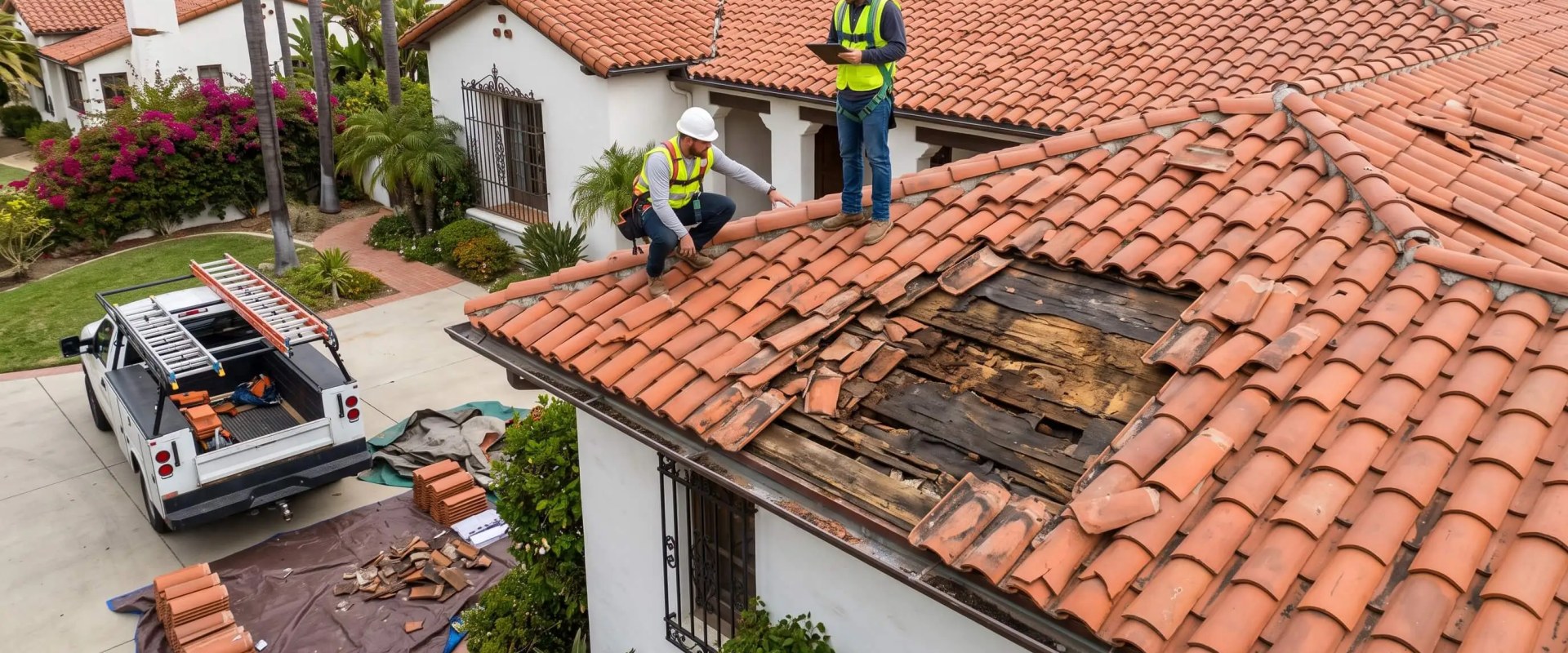
A water stain shows up on the bedroom ceiling after the first January storm, and suddenly every roofer you call has a different answer. One says patch it. Another says the whole thing has to go. We've been on enough Santa Barbara roofs to know both can be right, and that the deciding factor usually isn't the stain at all.
What decides it is whether the failure is local or whether the whole roof system is wearing out. That system has more parts than most people picture: the covering you see from the street, plus underlayment, flashing, decking and attic ventilation underneath. Each one ages on its own schedule. We've lifted a clay tile that still looked new after 60 years and found the felt beneath it gave up long ago. We've also seen tired-looking 18-year-old shingle roofs sitting on a perfectly sound deck that only needed one good repair.
Santa Barbara complicates things in two ways. Salt air off the channel works on flashing and fasteners all year. And much of the city, Montecito and the foothills sits in designated high fire hazard areas, where local code can turn a modest repair into a Class A roofing requirement before you've signed anything.
If you're weighing roofing in Santa Barbara right now, start with the questions below. When you want someone to look at your specific roof, an experienced roofing Santa Barbara contractor can tell you which side of that line you're on.
TL;DR Quick Answers
Roofing Santa Barbara
Good roofing in Santa Barbara starts with a diagnosis rather than a sales pitch. Hire a licensed roofing Santa Barbara company that inspects from the attic up, checks your fire zone before quoting, and hands you an itemized estimate comparing repair with replacement.
What to know before you hire:
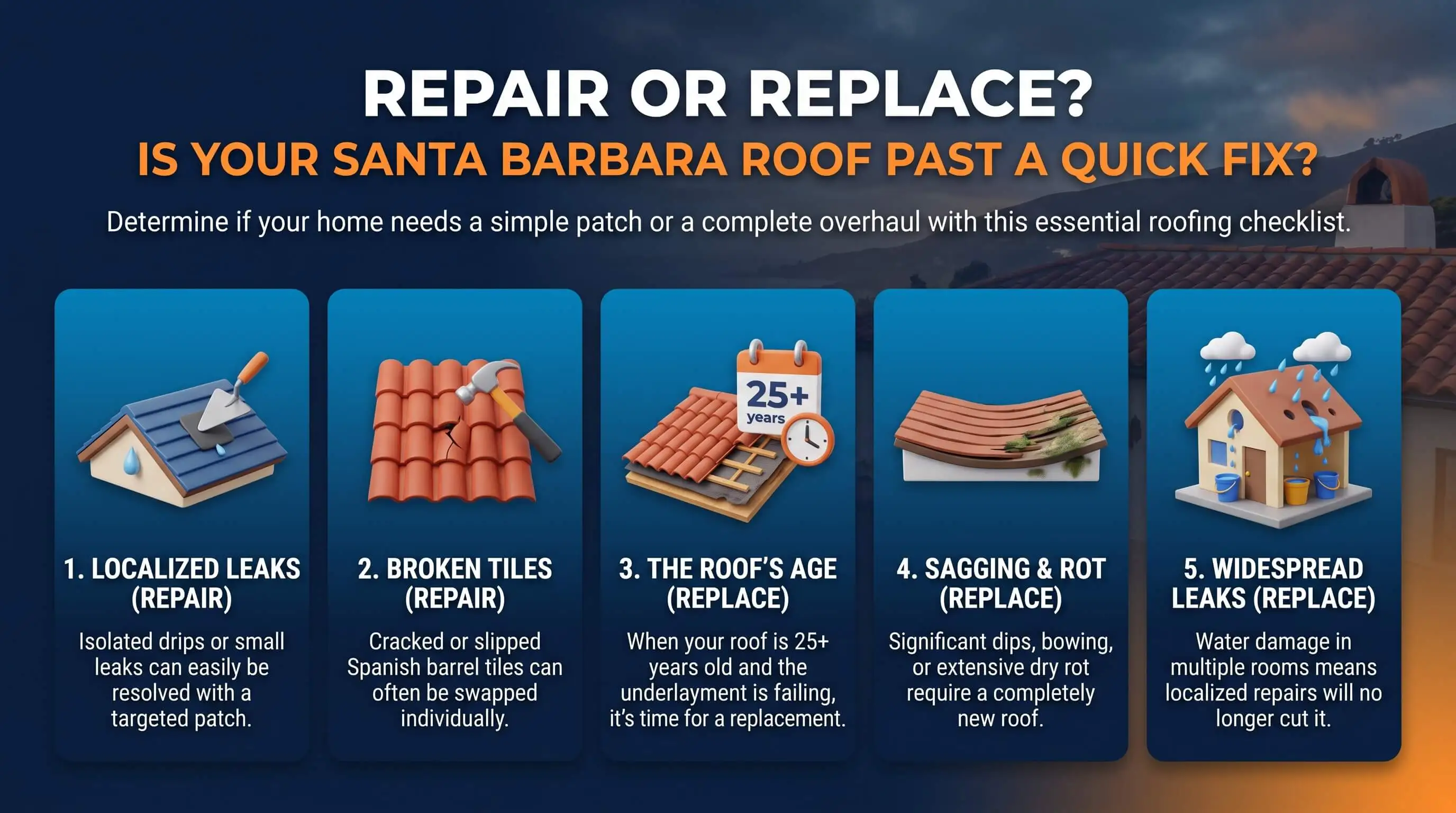
Repair fits damage confined to one area on a firm deck, usually on shingle roofs under about 15 years old
Replace when leaks recur or spread, the decking goes soft, or repairs reach roughly 30% of a new roof
Fire zones: City High Fire Hazard Areas require Class A or noncombustible roofing, even for repairs. County and Montecito Fire set their own replacement thresholds.
Clay tile: The tile can last 50 years or more, so failing underlayment often calls for a lift and re-lay instead of a tear-off
Coastal wear: Salt air corrodes flashing and fasteners first, which is why many leaks near the water start at the metal
Permits: A full replacement needs a building permit and a final inspection
Before you sign: Check the contractor's CSLB license, get the material's fire rating in writing, and compare itemized bids line by line
Top Takeaways
The repair-or-replace decision comes down to local failure versus system failure. A repair fits when you see:
One leak with a clear source
Damaged flashing, vents or a few tiles on an otherwise firm, dry deck
Replacement fits when the whole roof is wearing out:
Leaks in more than one spot, or leaks that keep returning
Soft decking or a visible sag
Repair quotes approaching roughly 30% of a new roof
A string of repairs over the last few years
Santa Barbara's fire codes can make the decision for you:
City High Fire Hazard Areas require Class A or noncombustible materials, repairs included
Wood shake patches stay under 20% of the roof within two years
County and Montecito Fire use their own thresholds, so confirm your jurisdiction first
Tile roofs play by different rules. The tile can outlast 50 years, but the underlayment usually wears out around 20 to 25 years , and a lift and re-lay often beats a full tear-off.
A reroof is the best chance you'll get to fix the attic:
Improve ventilation
Add ember-resistant vents
Have ductwork and insulation checked while access is easy
The Short Answer on Repair vs. Replacement in Santa Barbara
Repair makes sense when the damage stays in one area and the structure underneath is sound. Replacement makes sense once damage spreads across the roof, the decking goes soft, or the repair bill starts closing in on a meaningful share of a new roof. Here's how we weigh it when we're standing in a homeowner's driveway:
Age: Shingles under about 15 years usually earn a repair. Past 20 years, or tile underlayment past 20 to 25, we start talking about replacement.
Leaks: One leak with one source is a repair. Several leaks, or the same one coming back, is a pattern.
How much is damaged: Under 10% of the roof is repair territory. Wear spread across several slopes isn't.
Decking: If it's firm underfoot with no rot, keep going. Soft spots, sagging or dry rot change the conversation.
Repair cost: Once a repair quote reaches roughly 30% of replacement, we'd rather put that money toward the new roof.
Fire zone: Outside a high fire hazard area, or below the local threshold, a repair can go ahead. A repair scope that triggers Class A on a non-rated roof usually means replacement.
No single factor settles it. When two or three of them point toward replacement, though, patching is mostly buying time.
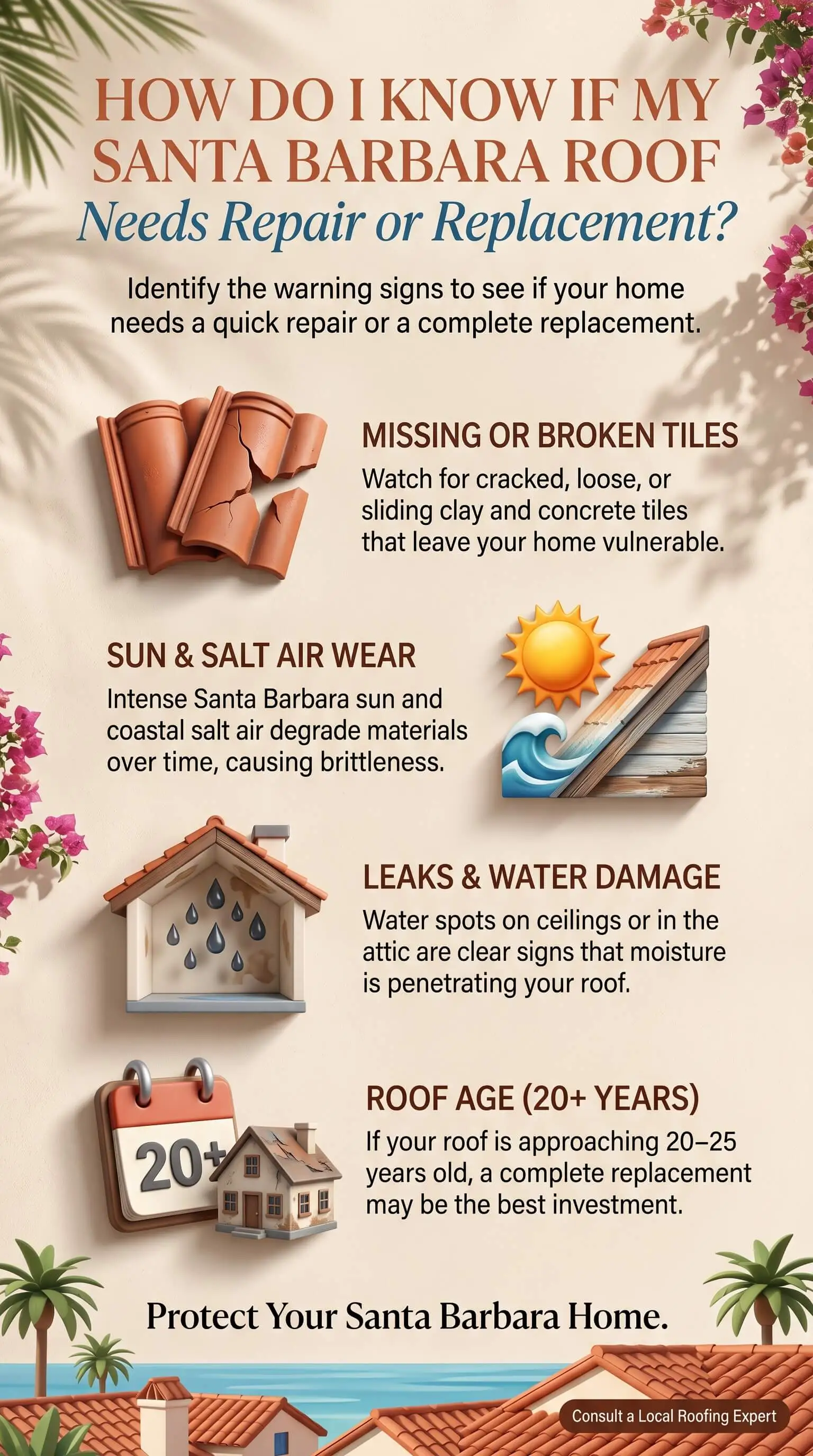
Signs Your Santa Barbara Roof Can Still Be Repaired
A roof is a good repair candidate when you can point to where the problem is. The repairable failures we see most often:
Flashing pulled loose or corroded at a chimney, skylight, wall or vent
A few cracked or slipped tiles, or shingles lifted by wind
Dried-out sealant around pipe boots and other penetrations
Storm damage on a single slope
Near the water, a surprising number of leaks start at the metal rather than the roof covering. Salt air eats at flashing and fasteners faster than it does tile or shingles. Fix the metal properly and the roof often has plenty of life left.
Signs It's Time for a Full Roof Replacement
Replacement is the better call when the roof is failing everywhere at once. These are the signs we take seriously:
Shingles curling, cupping or shedding granules into the gutters on more than one slope
Soft or spongy decking, or a sag you can see in the roofline
Water stains in more than one room, or stains that return after repairs
Daylight showing through attic boards
Tile underlayment that's dried out, torn or brittle across large sections
The clearest sign of all is a repair history. If a roof has been patched three or four times in a few years, each new repair is a bet on the weakest part of an old system, and that money usually does more good spent once.
How Santa Barbara's Fire Codes Can Turn a Repair Into a Replacement
Your fire zone can set the scope of the job before you or your roofer do. In the City of Santa Barbara's High Fire Hazard Areas, roof coverings on existing buildings have to be Class A or noncombustible fire-retardant materials, and that applies to repairs too. Wood shake and shingle roofs can only be patched with fire-retardant treated material, and only while less than 20% of the roof gets replaced within two years.
Outside the city limits the numbers change. In parts of unincorporated Santa Barbara County, replacing more than 50% of a roof in one year means the entire covering has to be at least Class A. The Montecito Fire Protection District draws a much tighter line, where replacing more than 10% of the roof area can require the whole roof to come up to a conforming Class A system.
Before you price any repair, we'd suggest two things. Find out which jurisdiction and fire zone your property falls under. Then ask your roofer to put the fire rating of the proposed material in writing.
For most homes this turns out to be a paperwork check, since standard asphalt fiberglass shingles and clay or concrete tile already carry a Class A rating. If you have an older wood shake roof, plan on a meaningful repair turning into a replacement.
Why the Underlayment Usually Fails First on Tile Roofs
Clay tile is the signature Santa Barbara roof, and it ages differently from shingles. The tile itself can last 50 years or more. The underlayment beneath it, which is what actually keeps the water out, usually doesn't make it that long.
When a tile roof starts leaking around the 20 to 25-year mark, the fix often falls somewhere between a spot repair and a full tear-off. We call it a lift and re-lay. The crew removes the tile, replaces the underlayment and flashing, then puts the original tile back with new pieces only where needed. It keeps the character of the home, avoids hunting for hard-to-match tile, and costs less than starting over. If a quote jumps straight to full replacement on a tile roof, ask whether this option was considered.
What Repair and Replacement Cost in Santa Barbara
Local pricing swings a lot with material, pitch, access and code requirements, so treat published ranges as a starting point. Typical estimates for Santa Barbara run roughly as follows :
Minor spot repair of a few shingles or tiles: about $250 to $600
Leak repair: about $400 to $1,200
Full flashing system replacement: about $900 to $2,500
Asphalt shingle replacement on an average-size home: about $5,500 to $12,000 and up
Clay tile replacement: about $18,000 to $40,000 and up
The biggest surprises tend to come from rotted decking that only shows up once the old roof is off, extra tear-off layers, permits and Class A requirements in fire zones. That's why we write every estimate line by line. An itemized scope is the only fair way to compare one bid against another.
How Your Roof Affects Your Attic, Ductwork and HVAC Bills
In a lot of Santa Barbara homes, the ductwork runs through the attic, right under the roof. When that roof is poorly ventilated or the underlayment is failing, heat and moisture build up exactly where your conditioned air travels.
Homeowners rarely connect these problems to the roof, but we see them often:
A hotter attic makes the air conditioner work harder and run longer
A slow leak can soak duct insulation and invite mold
Unscreened attic vents can let embers in during a wildfire
Poor airflow traps moisture that shortens the life of the roof deck itself
If the roof is coming off anyway, it's the cheapest moment you'll get to improve attic ventilation and install ember-resistant vents. While the attic is open, it's also worth having someone look at the hidden costs of HVAC ductwork before they become a separate project.
"We've spent 30 years on Santa Barbara roofs, and the mistake we see most is people looking at the wrong layer. A clay tile roof that leaks at 22 years almost never needs new tile. It needs new underlayment and careful flashing work. A shingle roof that's been patched four times in three years is a different story, no matter how it looks from the street. So we walk the attic before we walk the roof, because the decking tells you more than the shingles do. In the fire zones, we check the code before we write a number down, since the wrong repair can end up costing more than the right replacement. Any licensed roofing Santa Barbara company you hire should be willing to show you that reasoning in writing."
Essential Resources
Check Whether Your Home Falls Under Santa Barbara's High Fire Roofing Rules City of Santa Barbara, High Fire Requirements | santabarbaraca.gov This is the document that decides whether a repair has to be Class A. It lays out the City's roofing rules for High Fire Hazard Areas, including the limits on patching wood shake. If you live in the foothills, the Riviera or Mission Canyon, read it before you approve any roof work. https://santabarbaraca.gov/sites/default/files/documents/Community%20Development/Laws%20&%20Rules/High%20Fire%20Requirements%202019%20Code.pdf
See How County and Montecito Thresholds Differ From the City's Santa Barbara County Fire Safe Council, Wildfire Home Hardening Guide: Roofs | sbfiresafecouncil.org The County and Montecito Fire use different replacement thresholds than the City, and this guide explains both in plain language. It also lists which common roofing materials carry a Class A rating. We point Montecito and Hope Ranch homeowners here often. https://sbfiresafecouncil.org/wildfire-home-hardening-guide/chapters/roof.html
Look Over the County Reroof Permit Before Work Starts Santa Barbara County Planning and Development, Reroof Permit Application | County of Santa Barbara (hosted PDF) Reroofing in unincorporated Santa Barbara County goes through this permit, and the form itself reminds applicants to verify high fire design requirements. Reading it ahead of time makes it easier to ask a contractor who pulls the permit and when. https://content.civicplus.com/api/assets/62537ea7-e0df-4c91-9e3a-a4164f3140bc?cache=1800
Find Out Which Parts of a Roof Burn First University of California Agriculture and Natural Resources, Fire Network: Roof | ucanr.edu UC researchers show where roofs fail in a wildfire, including edges, valleys, vents, skylights and gutters packed with leaves. It's the clearest explanation we know of why a Class A covering alone doesn't finish the job. https://ucanr.edu/program/uc-anr-fire-network/roof
Learn Why Attic Vents Belong in the Reroof Plan Insurance Institute for Business and Home Safety, Ember Entry: Vents | ibhs.org IBHS has tested how wind-driven embers get into homes through attic vents. With the roof already open, swapping in ember-resistant vents costs far less than doing it later as its own job. https://ibhs.org/wildfire/ember-entry-vents/
Use CAL FIRE's Hardening Checklist Next to Your Estimate CAL FIRE, Ready for Wildfire: Hardening Your Home | readyforwildfire.org CAL FIRE calls the roof the most vulnerable part of a home and walks through ember sealing, drip edges and gutter choices. Hold it up against a roofing estimate and you'll see quickly whether anything at the roof edge was left out. https://www.readyforwildfire.org/prepare-for-wildfire/hardening-your-home/
Compare Your Roof's Age With Expected Material Lifespans National Association of Home Builders, Study of Life Expectancy of Home Components | NAHB report (hosted PDF) Most roofers lean on this study when they talk about lifespan. It gives a fair baseline for asphalt, tile, slate and wood, so you can tell whether your roof is aging early or right on schedule. https://sghac.com/site/wp-content/uploads/NAHB-Lifetimes.pdf
Together, these resources show how fire codes, permits, attic vents and material lifespans tie into one decision, much like professional HVAC installation depends on what's happening in the attic above it.
Supporting Statistics
Asphalt shingle roofs last about 20 years, while slate, copper and clay or concrete tile roofs last more than 50 years.
That gap explains most of the confusion we run into. A 20-year-old shingle roof has reached the end of its expected life, so recurring problems are a strong replacement signal. A 20-year-old tile roof is barely middle-aged on the surface, though its underlayment is often due. The same age can call for very different answers:
Shingles at 20 years: start planning for replacement
Tile at 20 to 25 years: check the underlayment and ask about a lift and re-lay before a tear-off
Soft decking overrides both. If the deck is going, the roof is going, whatever its age.
Source: National Association of Home Builders, Study of Life Expectancy of Home Components https://sghac.com/site/wp-content/uploads/NAHB-Lifetimes.pdf
In the Pacific region, an asphalt shingle roof replacement averaged $36,391 and recouped 76.2% of its cost at resale, compared with 67.5% nationally.
Few large projects hold their value at resale as well as a new roof, and our region does better than the national average. That matters if you plan to sell in the next few years. An aging roof can stall an escrow or invite a price cut once the buyer's inspector climbs up. Replacing it on your own timeline, instead of under that pressure, usually protects more of your home's value than one more patch would.
Source: JLC 2025 Cost vs. Value Report, Pacific Region https://www.jlconline.com/cost-vs-value/2025/pacific/
According to IBHS, embers are the leading cause of home ignition from wildfires.
For homes in Santa Barbara's high fire hazard areas, this changes how we think about repair versus replacement. Embers land on the roof first and look for a way in. The usual openings:
Gaps between the roof covering and the deck
Gutters and valleys full of dry leaves
Unscreened attic vents
Open eaves
A Class A covering, sealed edges and ember-resistant vents close most of those openings. If a repair can't get your roof to that standard, replacement is the safer choice.
Source: Oregon State Fire Marshal with the Insurance Institute for Business and Home Safety https://apps.oregon.gov/oregon-newsroom/OR/OSFM/Posts/Post/ibhs-osfm-demonstration
The roof over your attic affects every system below it, which is why plenty of HVAC system installation near me searches actually begin with an overheated attic.
Final Thoughts and Opinion
Most roof decisions we see go wrong in one of two directions. Some homeowners replace a roof that only needed new flashing or underlayment. Others keep patching a roof that stopped being worth patching years ago. In both cases the problem was the diagnosis, not the budget.
After three decades of roofing in Santa Barbara, here's where we land. Age tells you where to look, but it shouldn't make the decision for you. The decking and underlayment tell you far more than the surface you see from the street. And in the fire zones, the local code may decide before you do.
The homeowners who end up happiest with their choice tend to follow the same order:
Inspect from the attic up, not just the roof down
Confirm the fire zone and who issues the permit
Compare an itemized repair scope with an itemized replacement scope
Decide
Two cases deserve their own mention. Clay tile homes too often get a full replacement quote when a lift and re-lay would have kept the original tile and the look of the house. Wood shake roofs in high fire areas are the reverse, where patching usually isn't a legal option for long.
Our opinion is simple. Get the diagnosis first and let it drive the decision. A roofer who tells you to repair when repair is the right answer is a roofer you can trust when the answer is replaced.
Frequently Asked Questions
Q: How do I know if my roof needs repair or replacement in Santa Barbara?
A: Your Santa Barbara roof likely needs a repair if the damage sits in one area and the decking is solid. It likely needs replacement if leaks keep coming back or show up in several places, the deck feels soft, or a repair would cost around 30% of a new roof. Fire-zone rules can also require replacement once a repair passes local limits. The most reliable way to know is an inspection that starts in the attic.
Q: How long does a roof last in Santa Barbara's coastal climate?
A: Asphalt shingle roofs here usually last around 20 years, and clay or concrete tile can go 50 years or longer. Coastal salt air is hard on flashing, fasteners and sealants, so the metal often needs attention well before the roof covering does. On tile roofs, plan on new underlayment somewhere around 20 to 25 years even if the tile still looks great.
Q: Do I need a permit to repair or replace a roof in Santa Barbara?
A: Yes for a full replacement, which needs a building permit and a final inspection. Smaller repairs may not, and the cutoff depends on whether you're in the City, unincorporated County or the Montecito Fire district. In high fire hazard areas, even small repairs have to meet fire-rating rules. A licensed contractor should confirm the permit path with you before any work starts.
Q: Does my Santa Barbara home need a Class A fire-rated roof?
A: Quite possibly. In the City's High Fire Hazard Areas, roof coverings on existing homes, repairs included, must be Class A or noncombustible fire-retardant materials. The County and Montecito Fire require a full Class A roof once replacement passes their thresholds. Most asphalt fiberglass shingles and clay or concrete tile already qualify. Untreated wood shake does not.
Q: Is it cheaper to repair or replace a clay tile roof?
A: For a few broken tiles or a leak at the flashing, a repair is cheaper. When the underlayment has failed, a lift and re-lay usually costs much less than full replacement because the original tile goes back on over new underlayment. Full replacement mostly makes sense when the deck is damaged or the tile itself has worn out.
Get a Clear Answer on Your Roof
If you're still not sure which way your roof is leaning, start with a free on-site inspection and a written, itemized estimate that lays out repair and replacement side by side. A local roofer who knows Santa Barbara's fire zones, tile roofs and coastal weather can give you a straight answer, so you only pay for the work once. Request your free roof estimate and we'll take a look.