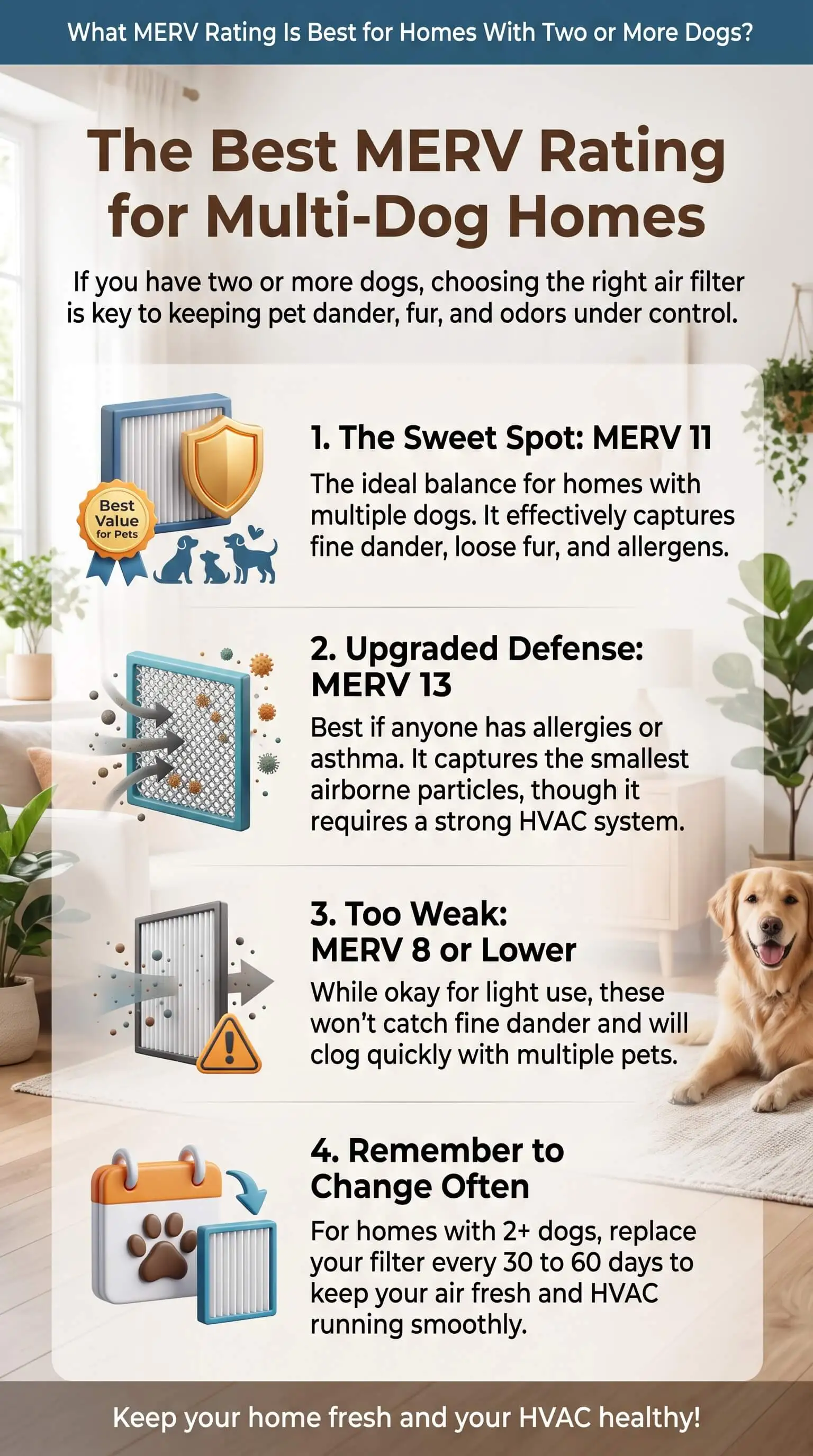
Two dogs put far more into your air than the fur you sweep off the couch. Most of it you'll never see, because the particles that carry dog allergen are small enough to stay airborne and ride the return vent straight to your filter. For most homes with two or more dogs, MERV 11 is the floor. Step up to MERV 13 if anyone in the house reacts to dogs and your system can handle the extra resistance.
Don't take that air for granted. The right rating, changed on a schedule built around your dogs, protects your family, your home, and your HVAC system with little effort. Consulting a professional for HVAC installation can also help ensure your system delivers proper airflow and filtration.
TL;DR Quick Answers
MERV rating chart
A MERV rating chart shows how well an air filter captures particles in three size bands, from 10 microns down to 0.3. Ratings run from 1 to 16, and each number marks the lowest efficiency the filter hit in testing. For homes with two or more dogs, the 1 to 3 micron band matters most.
MERV 1 to 4: Stops large debris over 10 microns, like hair clumps and lint.
MERV 5 to 8: Catches most dander flakes, pollen, and mold spores in the 3 to 10 micron range.
MERV 9 to 12: Adds the 1 to 3 micron band, where MERV 11 captures at least 65 percent.
MERV 13 to 16: Adds capture below 1 micron, with MERV 13 trapping at least 50 percent of 0.3 to 1 micron particles.
Dog Owner Tip: Start at MERV 11 for two or more dogs, and step up to MERV 13 for allergy households if your system allows it.
Top Takeaways
Baseline: Homes with two or more dogs should start at MERV 11.
Upgrade: MERV 13 suits allergy or asthma households when your system's limits allow it.
Why It Matters: Dog allergen travels on particles as small as 2 microns, smaller than MERV 8 handles well.
Change Interval: With multiple dogs, plan on 30 to 45 days and inspect monthly.
Odor: MERV doesn't rate smell, so reach for activated carbon.
Why a Second Dog Changes the Filter Decision
Every dog sheds hair, dander, and saliva residue, and every walk adds soil. Hair is easy to spot. What your filter fights is much smaller. A 2023 review in The Journal of Allergy and Clinical Immunology: In Practice found that Can f 1, the major dog allergen from dander, saliva, and glands, travels on particles roughly 2 to 15 microns across that stay airborne for extended periods.
Add a second dog and that supply of fine particles climbs every time your system pulls air through the return. That's why a filter that keeps up with one short-haired dog can fall behind once two dogs start shedding in spring and fall.
MERV Rating Chart for Dog Owners
ASHRAE created the Minimum Efficiency Reporting Value scale in 1987 to rate filters from 1 to 16 on how well they catch particles between 0.3 and 10 microns. Here's how it reads for dog owners.
MERV 1 to 4: Stops debris larger than 10 microns, such as clumps of hair and lint. They guard equipment more than lungs.
MERV 5 to 8: Covers the 3 to 10 micron range, home to most dander flakes, pollen, and mold spores. A MERV 8 filter has to catch at least 70 percent of those particles.
MERV 9 to 12: Adds the 1 to 3 micron range. MERV 11 catches at least 65 percent of particles there and at least 20 percent of the finest ones.
MERV 13 to 16: MERV 13 grabs at least 50 percent of 0.3 to 1 micron particles and 85 percent in the 1 to 3 micron range.
When you shop, keep this full MERV rating chart open to see every rating's minimum efficiency by particle band.
What E1, E2, and E3 Mean
Test labs split particles into three bands. E3 covers 3 to 10 microns, E2 covers 1 to 3, and E1 covers 0.3 to 1. Dander flakes mostly land in E3, but the smaller allergen-carrying fragments that hang in the air reach down toward E2. That's where MERV 11 and 13 earn their keep.
Why a MERV Rating Is a Floor
A filter's MERV number comes from the lowest efficiency it recorded in testing as it is loaded with dust. You can count on that minimum. The label can't promise anything once you leave the filter in so long that it chokes airflow and lets air slip around the frame.
MERV 8 vs MERV 11 vs MERV 13 for Multi-Dog Homes
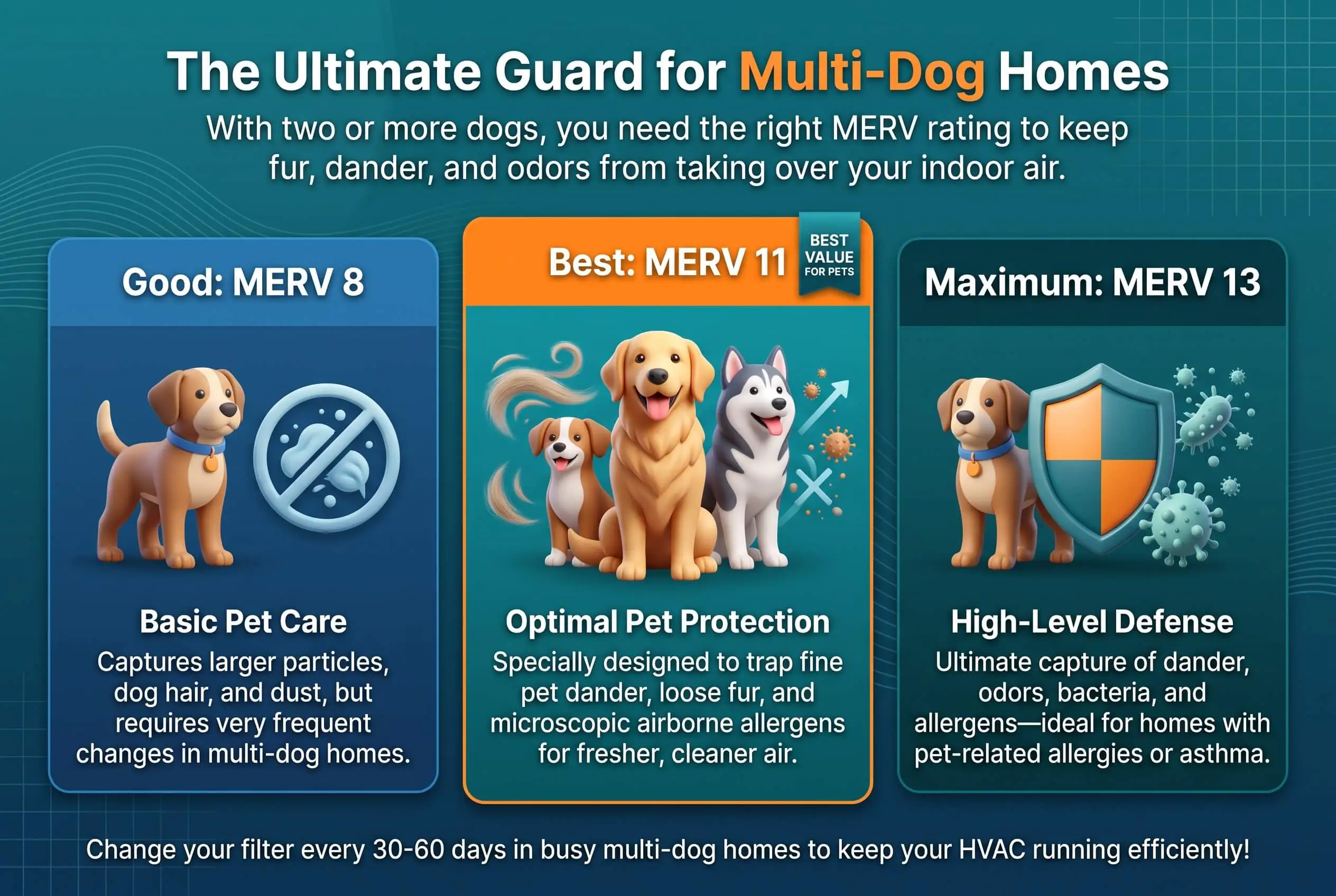
MERV 8: Good for Dust, Light for Dogs
MERV 8 catches visible hair, most dander flakes, and pollen with the least drag on airflow. Choose it when your manufacturer caps you at a lower rating. Just know it leaves much of the fine allergen load circulating.
MERV 11: The Multi-Dog Starting Point
For two or more dogs and nobody with allergies, I'd start here. MERV 11 adds solid capture in the 1 to 3 micron band without the resistance that comes with MERV 13.
MERV 13: The Pick for Allergy Households
The EPA advises a filter rated at least MERV 13, or as high as your system can take, and this rating meets that bar. Aim here if anyone at home sneezes around the dogs or lives with asthma. This breakdown of why many installers favor MERV 13 goes deeper.
Can Your HVAC System Handle MERV 13?
Most can. The EPA says most furnaces and HVAC systems run MERV 13 without equipment problems if you replace the filter often. ASHRAE still recommends checking your manufacturer's maximum initial resistance first, because denser media raises pressure drop, the resistance your blower pushes against. Before you upgrade, check two things.
Manufacturer Limits: Your equipment manual may list a maximum MERV rating or a rated pressure drop.
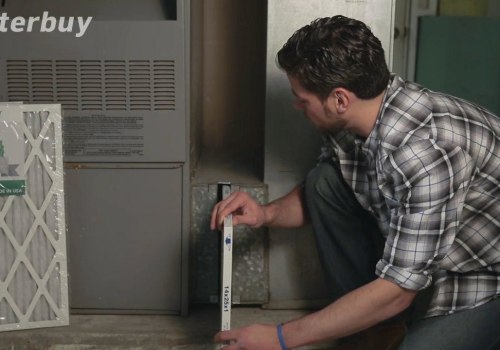
Filter Depth: A 4-inch filter spreads air across far more pleated media than a 1-inch filter, so it carries MERV 13 with less strain. Unsure what your slot holds? See how standard filter sizes work.
After the swap, pay attention to the vents. Weaker airflow, longer run times, or frost on the indoor coil all point to too much resistance. If you see any of them, drop to MERV 11 and call a licensed technician.
How Often to Change Filters With Two or More Dogs
The EPA says manufacturers typically recommend a new filter every 60 to 90 days, and ENERGY STAR suggests a monthly check. Two or more dogs shorten that window. My rule of thumb is 30 to 45 days, leaning toward 30 during spring and fall shedding. At the 30-day mark, pull the filter and hold it up to a light. Gray, matted pleats mean it's done.
What a Filter Alone Won't Fix
MERV ratings measure particles, and odor is a gas, so smell falls outside the scale. An activated carbon filter or a portable air cleaner with a carbon stage takes care of it. Your HVAC filter also cleans air only while the system runs, and the EPA says that's often less than 25 percent of the time during heating and cooling seasons, so longer fan runs mean more filtered air. Pair the right filter with cleaning habits that cut pet dander and you're working the problem from both ends.
“Hair is rarely what takes a filter down in the two-dog homes I service. Fine dander packs the pleats from the inside, so a MERV 11 that still looks clean on the intake side has the blower working harder by week five. I set the change interval by the dogs, not the calendar.”
Essential Resources
See Every Rating Side by Side
The MERV rating chart linked above lays out MERV 1 through 16 by particle band.
Get the Federal Benchmark for Home Filters
The EPA's Guide to Air Cleaners in the Home covers the agency's MERV 13 recommendation, replacement timing, and how to tell whether your system can handle a higher rating.
Know the Minimum Residential Standard
ASHRAE's residential filtration recommendation sets MERV 6 as the floor in its ventilation standard and explains why higher ratings call for a resistance check.
Build a Monthly Filter-Check Habit
The ENERGY STAR heating and cooling maintenance checklist recommends monthly filter checks and notes that a dirty filter drives up energy costs.
Understand How Dander Behaves Indoors
The American Lung Association's guide to pet dander shows why these tiny, jagged particles stay airborne and cling to furniture and bedding.
Clear Up the Hypoallergenic Myth
The American Academy of Allergy, Asthma & Immunology explainer on what pet allergy is confirms that every dog carries allergy-causing proteins in its dander, saliva, and urine.
Plan for Allergens That Linger
The Minnesota Department of Health's guidance on pet triggers notes that dander levels can take up to six months of regular cleaning to come down.
Supporting Statistics
Nearly 90 Million Dogs Share U.S. Homes
The AVMA's 2024 pet population report counted 89.7 million dogs living in 59.8 million dog-owning households. That works out to about one and a half dogs per dog-owning home.
Dog Allergen Travels on Particles as Small as 2 Microns
A 2023 review of indoor allergens reports that Can f 1 rides on 2 to 15 micron particles that stay airborne for extended periods. It also notes that 54 percent of U.S. households have at least one dog.
Up to 1 in 5 People React to Cats and Dogs
Cat and dog allergies affect 10 to 20 percent of the world's population, according to the Asthma and Allergy Foundation of America.
Final Thoughts and Opinion
I'd call MERV 8 a compromise for any home with two or more dogs. Start at MERV 11, and move to MERV 13 once allergies enter the picture and your system allows it. Where most people slip is the schedule. A clogged MERV 13 does your family less good than a fresh MERV 11, so put as much thought into when you change the filter as into which one you buy, and time it to your dogs. A few minutes a month keeps you ahead of it.
Frequently Asked Questions
Is MERV 13 Too High for a Home With Dogs?
Not for most systems. The EPA says most furnaces and HVAC systems handle MERV 13 without trouble as long as you change the filter often. Check your manual for a maximum rating before you switch, and drop to MERV 11 if airflow weakens.
Does MERV 8 Catch Dog Hair and Dander?
It catches the larger pieces. MERV 8 traps at least 70 percent of particles in the 3 to 10 micron range, which covers hair, lint, and most dander flakes. Smaller allergen-carrying particles get through more often, so multi-dog homes do better with MERV 11 or higher.
Is MERV 11 Enough for Two Dogs?
For most households without allergies, yes. MERV 11 adds capture in the 1 to 3 micron range and keeps airflow resistance moderate. If someone at home has dog allergies or asthma, go with MERV 13.
Do Hypoallergenic Dog Breeds Let Me Use a Lower MERV Rating?
No. The AAAAI says every dog carries allergy-causing proteins, and the 2023 allergen review reports similar Can f 1 levels in homes with hypoallergenic and regular breeds. Pick your filter by how many dogs you have and who lives with them.
Will a Higher MERV Rating Remove Dog Odor?
Not by itself. MERV measures particle capture, and odors are gases. For smell, use an activated carbon filter or a portable air cleaner with a carbon stage.
How Do I Read a MERV Rating Chart?
Find your rating, then look at its minimum capture across three bands: 3 to 10 microns, 1 to 3 microns, and 0.3 to 1 micron. For dog owners, the middle band matters most, since that's where a filter starts catching smaller allergen-carrying particles.
Match Your Filter to Your Pack
Your best MERV rating is the highest one your system handles comfortably, and for a home with two or more dogs that starts at MERV 11. Check your equipment's limit, pick your rating from the chart above, and set a 30-day filter reminder so the air your dogs share with your family stays cleaner all year.